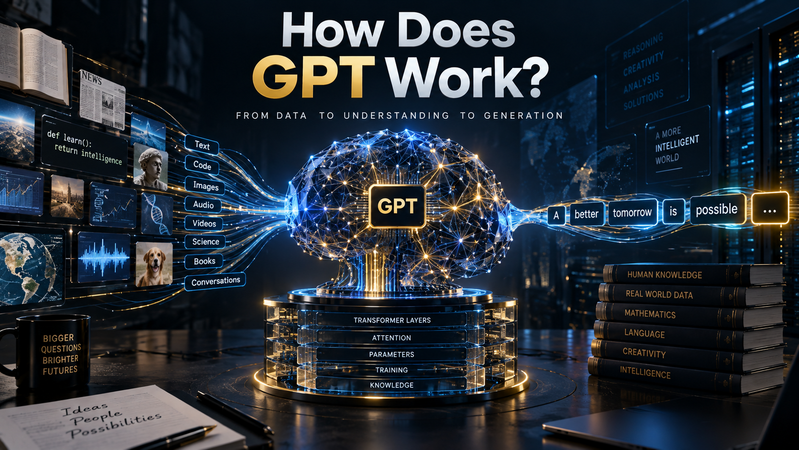
When you type a question into ChatGPT and receive an answer within seconds, it can feel almost magical. You ask about mathematics, write an email, explain a difficult concept, generate code, or continue a story—and the system responds in natural language.
But underneath that simple experience is a surprisingly interesting idea.
At its core, GPT is a language model. Its basic job can be described in a very simple way: predict what comes next in a sequence of text. Yet when that simple task is performed by a very large neural network trained on enormous amounts of data, something much more powerful can emerge.
This raises an obvious question: How does GPT work if its basic task is simply predicting the next word?
The answer involves neural networks, weights, training, transformers, attention, optimization, and the huge amount of information contained in language.
The important point is that GPT does not work like a traditional computer program where an engineer writes a separate rule for every question. Instead, it learns patterns from data and stores what it has learned in the parameters—or “weights”—of a neural network.
Let’s break that process down from the beginning.
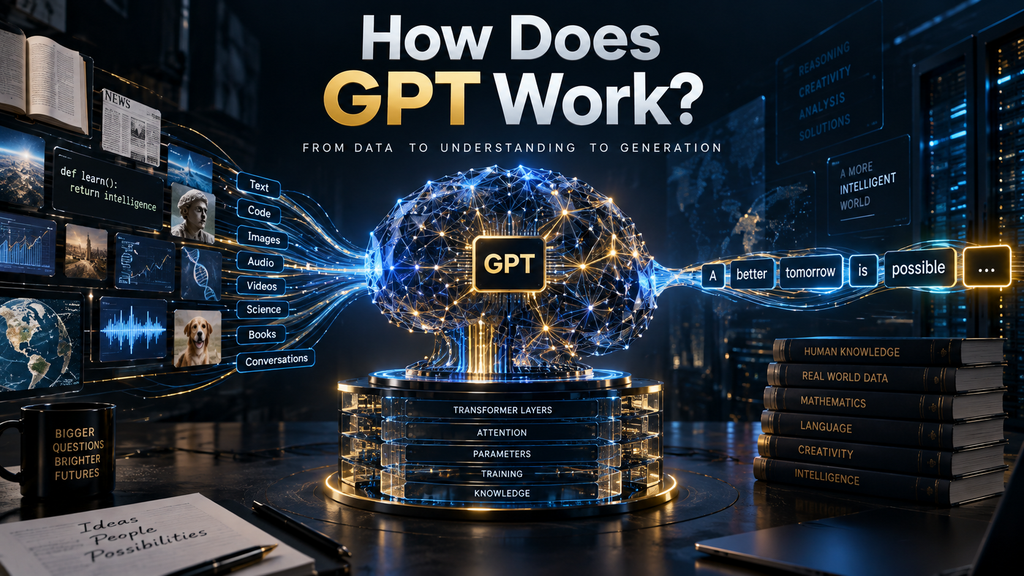
Table of Contents
What Is GPT?
GPT stands for Generative Pre-trained Transformer.
The name itself gives us clues about how the system works.
- Generative means it can generate new content.
- Pre-trained means it first learns from a large collection of data before being used for particular tasks.
- Transformer refers to the neural network architecture used by GPT-style models.
The most important concept to understand is the language model.
A language model attempts to predict what text should come next based on what came before it. This idea is not new. Language models existed long before modern GPT systems. Earlier approaches included statistical models called n-gram models, which essentially counted how often particular combinations of words appeared and used those counts to predict the next word. Neural networks were later applied to language modeling as well.
What changed dramatically was the combination of large neural networks, enormous datasets, and the transformer architecture.
That combination allowed a relatively simple training objective to produce surprisingly sophisticated behavior.
How Does GPT Learn From Text?
Imagine giving a model a sentence such as:
“The child opened the door and walked into the…”
The model has to estimate what comes next.
Perhaps the answer is “room.”
The model makes a prediction, compares that prediction with the training data, calculates how wrong it was, and then adjusts its internal parameters.
This process happens again and again across an enormous amount of text.
The important part is that GPT is not simply memorizing a giant list of sentences and looking them up whenever you ask something.
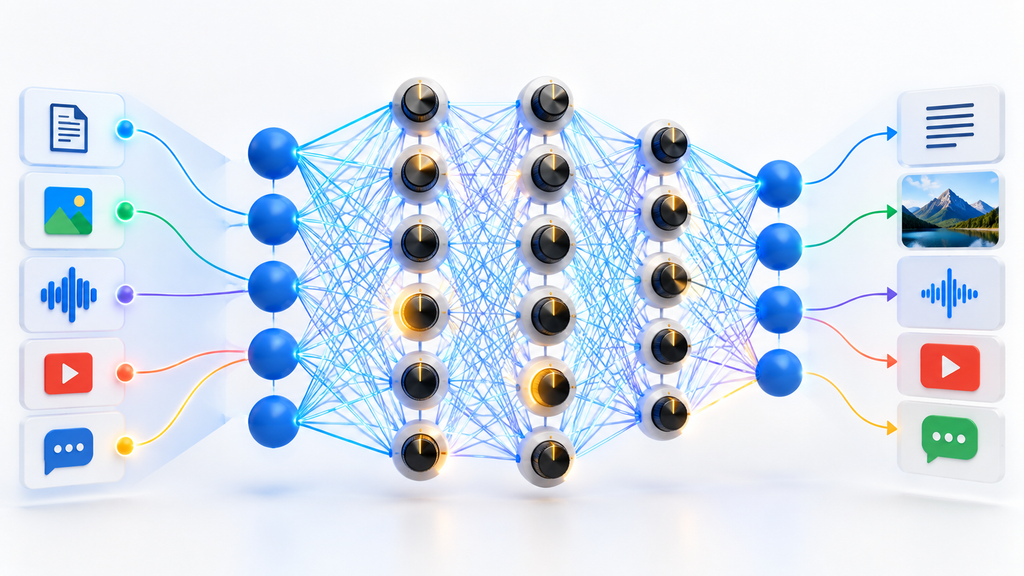
Instead, the neural network contains a huge collection of adjustable parameters, commonly described as weights. These parameters are gradually changed during training so that the model becomes better at predicting the next token.
A useful way to imagine those parameters is as millions or billions of adjustable “knobs.” The neural network’s job during training is to find settings for those knobs that allow it to perform its task effectively. In the discussion that forms the basis of this article, Andrej Karpathy describes neural networks in essentially these terms: a mathematical expression containing many trainable parameters whose settings are adjusted to produce desirable behavior.
The surprising part is what happens when there are enough knobs and enough training data.
Why Predicting the Next Word Becomes Much More Powerful?
At first, predicting the next word sounds like a very limited task.
If someone tells you:
“India is the capital of…”
you can probably predict the expected continuation because you know something about geography.
But consider a much more complicated sentence:
“After heating the solution, the scientist observed that the…”
To predict the next word accurately, the model may need to recognize the context of an experiment.
Now consider a technical programming discussion, a legal document, a physics explanation, or a conversation about human behavior.
Each requires different knowledge.
This is where the simple next-token objective becomes interesting.
A model trained on a sufficiently large collection of text encounters countless examples involving science, history, mathematics, programming, culture, human behavior, and everyday communication. To predict the next piece of text accurately across all these situations, the model needs to learn patterns about the information contained in those texts.
Karpathy describes this as an important reason that large language models develop unexpected capabilities. Although the training objective may be simple, predicting the next word across a huge and varied dataset effectively brings many different kinds of problems into the same learning process.
This is one of the central ideas behind GPT.
The task is simple. The information required to perform the task well is not.
What Is a Neural Network?
A neural network is a mathematical system designed to transform inputs into outputs using many adjustable parameters.
The name comes partly from its original inspiration: biological neural networks in the brain.
But it is important not to take the analogy too literally.
A trained artificial neural network is not simply a digital copy of a human brain. The mechanisms that create biological brains and artificial neural networks are very different.
A useful mental model is to think of a neural network as a huge mathematical function with many adjustable parameters.
You provide an input.
The network performs a sequence of mathematical operations.
It produces an output.
During training, its parameters are adjusted so that the output becomes increasingly useful for the task.
In GPT, the input is text and the output is a prediction about what should come next.
The remarkable behavior comes from the scale and complexity of this process.
What Are the “Weights” Inside GPT?
The weights are among the most important parts of a neural network.
During training, the model continuously adjusts them.
Suppose the model predicts the wrong next token. Training calculates how much the model’s prediction was wrong and determines how the parameters should change to reduce that error.
This is where backpropagation and gradient descent become important.
Backpropagation calculates how the error relates to different parameters throughout the network. Gradient descent then uses that information to adjust those parameters.
These adjustments happen repeatedly across enormous numbers of training examples.
Over time, the network develops internal representations that help it make increasingly accurate predictions.
This is why it is misleading to imagine GPT as a database containing a simple answer for every possible question.
Its capabilities arise from the learned patterns represented in its parameters.
What Is a Transformer?
The “T” in GPT refers to Transformer.
The transformer architecture became one of the most important developments in modern AI because it provided an effective way to process relationships between pieces of information.
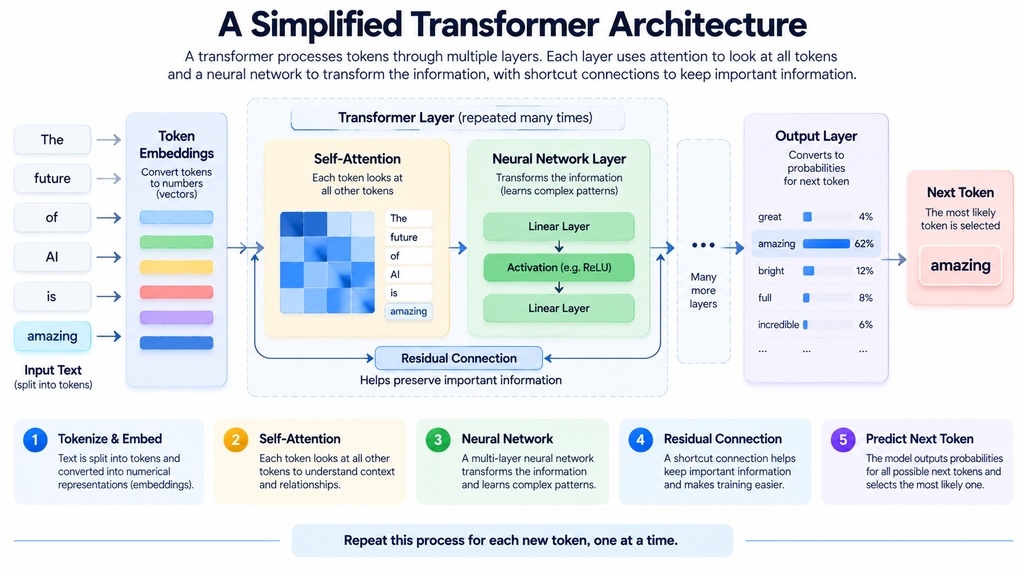
A transformer is much more than just its attention mechanism. It includes several architectural components working together, including attention, multilayer perceptrons, residual connections, normalization and other elements.
One useful way to understand the transformer is as a system that allows different pieces of information to interact.
Imagine a sentence containing several words.
Not every word is equally important for predicting the next one.
The model needs to determine which parts of the existing context matter most.
That is where attention becomes important.
How Does Attention Help GPT Understand Context?
Attention allows the model to consider relationships between different parts of the input.
For example, consider:
“Ravi put the book on the table because it was heavy.”
What does “it” refer to?
Understanding the sentence requires looking at other words in the surrounding context.
In a transformer, attention mechanisms allow representations at different positions to interact. One part of the sequence can effectively determine which other pieces of information are relevant.
Karpathy describes this as a kind of message-passing system: different nodes contain vectors, examine information from other nodes, determine what is relevant, and update their representations.
This ability to work with relationships across a sequence is one reason transformers became so powerful for language.
Why Is the Transformer So Important?
The transformer has several properties that make it particularly useful for large-scale machine learning.
One is expressiveness.
It can represent many different types of computations.
Another is optimizability.
The architecture works well with techniques such as backpropagation and gradient descent, which are used to train neural networks.
The third is computational efficiency.
Modern hardware such as GPUs is particularly effective at performing large numbers of mathematical operations in parallel. Transformer computation can take advantage of this parallelism.
This combination is extremely important.
A neural network can theoretically be powerful, but if it is extremely difficult to train or inefficient to run on available hardware, scaling it becomes much harder.
The transformer brought together these desirable properties in a way that made very large models practical.
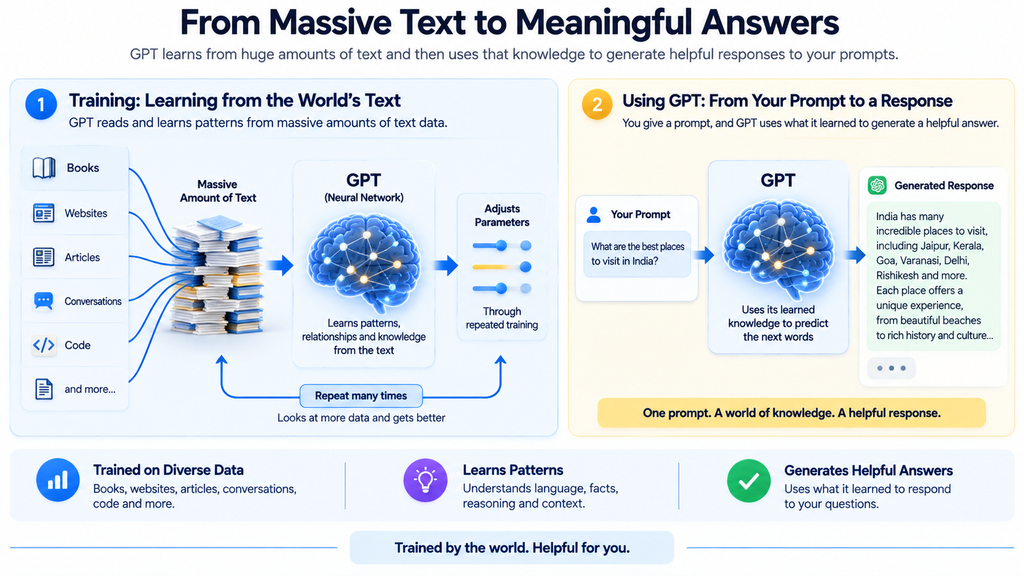
How Does GPT Go From Training to Answering a Question?
There are two very different stages to understand:
Training and inference.
Training
During training, the model processes enormous quantities of data.
It repeatedly tries to predict the next token.
When the prediction is wrong, the model’s parameters are adjusted.
This happens over and over again.
The objective may look simple, but the scale of the process is what makes it powerful.
Inference
Once the model has been trained, you can give it a prompt.
For example:
“Explain gravity to a 10-year-old.”
The model processes your input and generates a sequence of tokens that it predicts will form an appropriate continuation.
It generates one token, then uses the growing context to help predict the next one, continuing until it produces a complete response.
So when GPT writes an answer, it is not necessarily retrieving a prewritten paragraph from a database.
It is generating a response based on the patterns represented in the trained model and the context supplied in the conversation.
Does GPT Really Understand What It Is Saying?
This is one of the most difficult questions raised by modern language models.
From a practical perspective, large models clearly develop representations that allow them to work with concepts, relationships, language and information.
Karpathy’s view in the transcript is that a sufficiently capable model must capture a significant amount about the world in its weights in order to predict text effectively.
But “understanding” can mean different things.
Human understanding involves perception, physical experience, memory, emotions, biological processes, interaction with the environment and many other things.
A language model primarily learns from its training data and operates through computation.
Therefore, it is useful to distinguish between functional understanding—being able to represent and manipulate information effectively—and the broader philosophical question of whether that is equivalent to human understanding.
The transcript does not establish that GPT understands the world in exactly the same way a human does.
Why Can GPT Solve Problems It Was Not Specifically Programmed For?
This is where the idea of emergent behavior becomes important.
A model is not necessarily trained with a separate program for every task it can perform.
Instead, a broad training objective can cause the network to develop internal capabilities that become useful across many tasks.
For example, predicting text accurately may require learning about grammar.
But grammar alone is not enough.
The model may also need to recognize relationships between concepts, understand common patterns in explanations, recognize mathematical structures, identify programming conventions and distinguish different styles of communication.
As the network becomes larger and the training data becomes more extensive, these capabilities can interact.
The result can look surprising because the original objective—predict the next token—appears much simpler than the behavior that eventually emerges.
This is one of the most fascinating aspects of GPT.
What Is In-Context Learning?
Another important capability discussed in the transcript is in-context learning.
In simple terms, the model can often learn how to respond to a task from the examples or instructions contained in the prompt itself.
For example, you might provide:
“Apple → fruit
Carrot → vegetable
Mango →”
The model can infer the pattern and continue with “fruit.”
It does not necessarily require its underlying weights to be permanently changed for that particular interaction.
Instead, the prompt provides context that influences the model’s next predictions.
This ability became an important part of the development of GPT-style systems. The transcript specifically identifies in-context learning as one of the striking properties that became visible with larger GPT models.
Is GPT Just Memorizing the Internet?
It is tempting to think of GPT as a giant copy of the internet.
That is an incomplete picture.
The model is trained using large amounts of text, but the information becomes represented through the model’s learned parameters.
It learns statistical and conceptual patterns from the training process.
At the same time, training on text has limitations.
Text is a communication medium created by humans. People do not write down every piece of knowledge they possess.
For example, humans understand many basic physical facts without constantly explaining them in writing.
We know that objects fall when dropped. We understand many aspects of physical interaction without needing to describe every detail in a document.
The transcript highlights this limitation: text contains enormous amounts of knowledge, but it is not necessarily a complete representation of everything humans know about the physical world.
This is one reason multimodal learning—working with text, images, audio and video—becomes important.
Why Might GPT Need More Than Text?
If an AI system only reads text, it primarily learns from how humans describe and communicate about the world.
But the world itself contains information that is difficult to express completely through text.
A video contains motion.
An image contains visual relationships.
Audio contains sound and timing.
Physical interaction provides information about cause and effect.
This leads to an important question: could an AI system become more capable by interacting with the world instead of only reading descriptions of it?
The transcript explores exactly this idea.
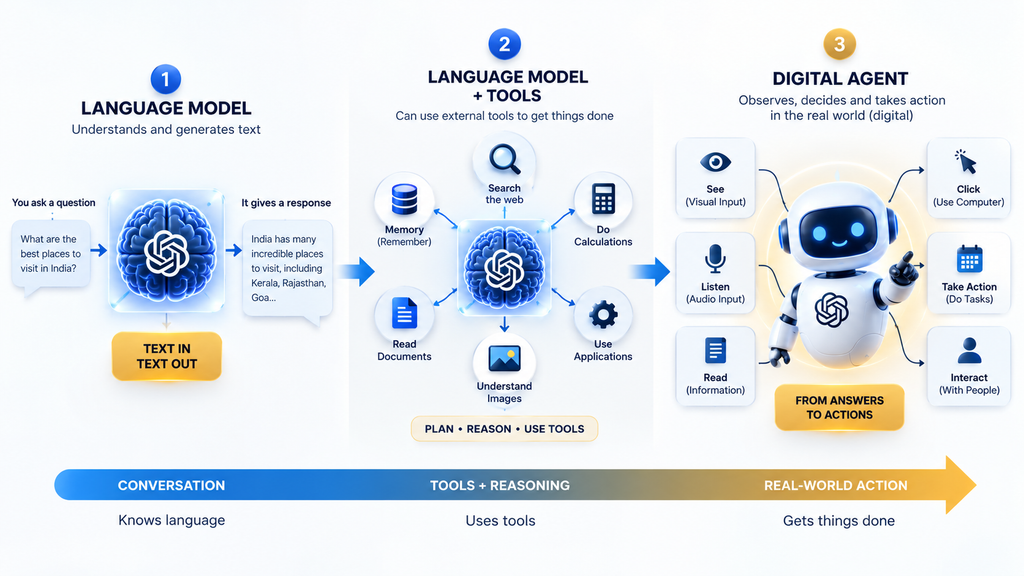
From Reading the Internet to Acting on It!
Karpathy discusses an earlier project called World of Bits, which explored giving neural networks access to a keyboard and mouse.
Instead of simply reading information, an agent could observe a computer screen and take actions such as clicking buttons and interacting with websites.
The early approach had a major problem.
If an agent started from scratch, it had to discover almost everything through trial and error.
Imagine giving a computer control to an agent that does not understand what a button, booking form or webpage means.
It could randomly press keys and click locations, but successfully completing a complicated task would be extremely unlikely.
This is related to the sparse reward problem in reinforcement learning.
The system may perform many actions before receiving meaningful feedback about whether it succeeded.
The transcript describes this early approach as extremely inefficient because the system had no useful prior representation of the task.
A pre-trained language model changes the situation.
If the model already understands concepts such as “booking,” “submit,” “website” and “form,” it starts with useful representations rather than beginning from zero.
That makes the transition from simply observing information to taking actions much more practical.
What Are the Limitations of GPT?
Understanding how GPT works also means understanding what it does not automatically guarantee.
GPT Can Be Limited by Its Training Data
If the model learns from data, the quality and coverage of that data matter.
The internet contains an enormous amount of information, but it is not a perfect representation of reality.
It contains incomplete information, conflicting information and human-created errors.
Text Is Not the Entire World.
A large text dataset provides tremendous knowledge, but physical reality cannot be completely captured in writing.
This is one reason researchers have explored images, audio, video and interaction as additional sources of information.
More Parameters Do Not Automatically Solve Every Problem.
Increasing model size can produce powerful capabilities, but architecture, data, optimization and evaluation also matter.
The transcript describes the transformer as remarkably resilient while noting that researchers continue to investigate improvements and alternatives.
Language Generation Is Not the Same as Guaranteed Truth.
A language model is fundamentally trained to generate likely continuations.
That does not mean every generated statement is automatically correct.
The ability to produce fluent language and the ability to establish truth are different problems.
This distinction is important whenever people use AI for mathematics, science, business, programming or other areas where accuracy matters.
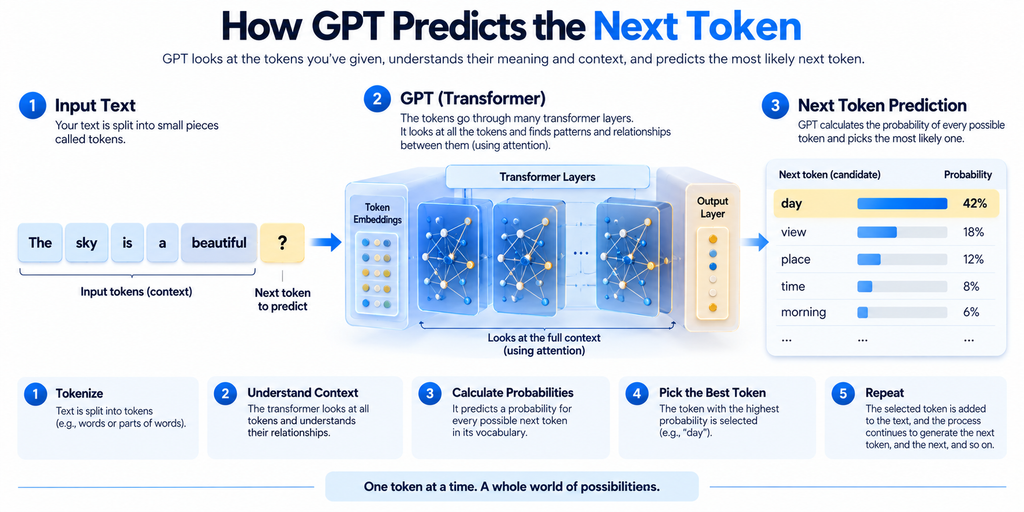
So, How Does GPT Work in Simple Terms?
The entire process can be reduced to a sequence of ideas.
First, GPT is a neural network.
It contains a very large number of adjustable parameters.
Second, it is trained on large amounts of data.
For language models, text provides the primary training material discussed in the transcript.
Third, it learns to predict the next token.
The model repeatedly attempts to predict what comes next in a sequence.
Fourth, its parameters are adjusted during training.
Backpropagation and gradient-based optimization help improve those predictions.
Fifth, the transformer allows information within the context to interact.
Attention and other transformer components help the network determine which pieces of information are relevant to one another.
Sixth, the trained model can generate responses.
When you provide a prompt, the model uses that context and its learned representations to generate a sequence of predicted tokens.
And this is where the apparent simplicity ends.
The basic instruction is:
Predict what comes next.
But to become very good at that task across a huge range of text, the model can develop internal representations that capture patterns involving language, concepts, reasoning, knowledge and human communication.
That is why a system that began with what sounds like a simple prediction task can become capable of performing many different kinds of work.
The Bigger Idea Behind GPT–
Perhaps the most interesting lesson is that sophisticated behavior does not always require an equally complicated objective.
The objective can be simple.
The system can still become complex.
A transformer is a mathematical architecture, but when combined with large amounts of data, optimization and computational power, it can learn solutions that are difficult to anticipate simply by looking at the original training objective.
That is the central idea behind the modern language-model revolution.
GPT does not need a human programmer to manually write a rule saying:
“If the user asks about physics, do this.”
Instead, training allows the model to discover patterns that help it produce useful continuations across many different contexts.
The result is a system that can appear surprisingly flexible.
And perhaps that is the most important answer to the question “How does GPT work?”
GPT works by combining a relatively simple learning objective with an extraordinarily large and flexible neural network.
It learns from patterns.
Its parameters store the results of that learning.
The transformer provides the architecture that allows those representations to interact.
And when the model is given a prompt, it uses everything encoded in those parameters—together with the current context—to predict what should come next.
What looks like a conversation on the surface is therefore the visible result of a huge amount of mathematical computation happening underneath.
The fascinating part is not that GPT can predict the next token.
The fascinating part is how much the model can learn about language and the world in order to become good at doing it.
Frequently Asked Questions–
Is GPT simply predicting the next word?
Broadly speaking, yes, but modern systems usually work with smaller pieces of text called tokens rather than always predicting complete words. The important idea is that the model predicts what token should come next based on the context it has received.
What does GPT learn during training?
GPT learns patterns represented in the parameters of its neural network. These patterns can involve language, concepts, relationships and many other features of the training data.
What is a transformer in GPT?
A transformer is the neural network architecture used by GPT-style models. It contains components such as attention, multilayer perceptrons, residual connections and normalization.
What is attention in a transformer?
Attention allows different parts of the input to interact and helps the model determine which information is relevant when processing a particular context.
Does GPT understand language like a human?
The transcript supports the idea that large language models develop forms of understanding represented in their weights, because predicting language well across diverse contexts requires capturing significant patterns about the information being discussed. However, whether this is equivalent to human understanding is a deeper question.
Why can GPT perform different tasks if it is trained to predict text?
A large language dataset contains many different kinds of information. Predicting text accurately across that dataset can therefore require learning patterns related to many different tasks and domains. This can lead to capabilities that were not individually programmed into the model.
Why is the transformer architecture important?
Transformers combine expressive computation, trainability through methods such as backpropagation and gradient descent, and efficient parallel computation suited to modern hardware.
Does GPT know everything on the internet?
No. A language model’s training data is not a perfect representation of the internet or reality. The transcript also points out that text itself does not contain everything humans know about the physical world.
Can GPT learn from interaction with the world?
The transcript discusses this as an important direction. Systems that can interact with digital environments through interfaces such as screens, keyboards and mice could potentially learn from acting rather than only observing.
What is the simplest way to explain GPT?
A simple explanation is: GPT is a large neural network trained to predict the next token in context. During training, its parameters are adjusted so that its predictions become better. During use, it generates responses one token at a time based on the prompt and what it learned during training.
Internal Linking Opportunities
[INTERNAL LINK: What Is Artificial Intelligence?] — Link from the opening discussion of AI and neural networks.
[INTERNAL LINK: How Do Large Language Models Work?] — Link from the sections explaining language models, training and next-token prediction.
[INTERNAL LINK: What Is a Transformer in AI?] — Link from the detailed explanation of transformer architecture and attention.
[INTERNAL LINK: What Is Machine Learning?] — Link from the explanation of training, backpropagation and gradient descent.
Image Alt Text
Image 1: Diagram showing how GPT predicts the next token from a sequence of text.
Image 2: Simplified transformer architecture showing attention, neural network layers and information flow.
Image 3: Illustration showing GPT training on large amounts of text and generating a response from a user prompt.