When people say that an artificial intelligence model has been “trained,” it can sound as if someone sat down and taught the computer everything it knows.
That is not really how AI training works.
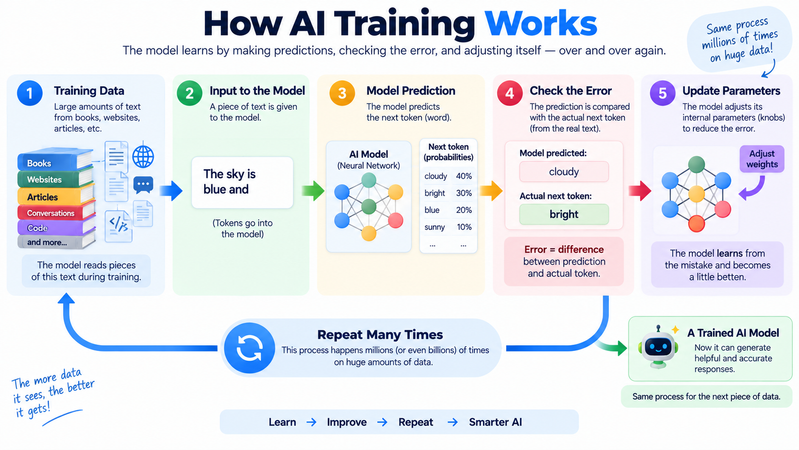
A modern AI model is built with a mathematical system containing a large number of adjustable values. During training, the system is exposed to data and repeatedly optimized so that its output becomes better at a particular task.
But there is a deeper question: what exactly is being changed when an AI learns?
The answer takes us to one of the most important ideas behind modern artificial intelligence: neural networks have parameters that can be adjusted, and training is largely the process of finding useful settings for those parameters.
This simple idea becomes surprisingly powerful when the network is large, the training problem is difficult, and the amount of data is enormous.
GPT is a particularly interesting example. A GPT model can be trained on large amounts of text by repeatedly trying to predict what comes next. That sounds simple. Yet, at sufficient scale, the model can develop capabilities that go far beyond simply completing a sentence.
So, what is AI training, how does it work, and why can such a straightforward process produce sophisticated AI systems?
Table of Contents
What Does AI Training Actually Mean?
AI training is the process of adjusting the internal parameters of an artificial intelligence model so that it becomes better at a specific objective.
A neural network can be thought of as a mathematical system with many adjustable “knobs.”
These knobs are not physical controls. They are numerical parameters inside the model.
The training process tries to find settings for these parameters that make the network perform the desired task.
For example, a neural network might be trained to:
- recognize objects in images,
- predict the next piece of text,
- classify information,
- translate language,
- generate content,
- recognize speech,
- or perform another computational task.
The basic idea is therefore not that an engineer manually programs every possible answer into the system.
Instead, the model is optimized through repeated exposure to training examples.
The transcript describes neural networks in this way: they are mathematical expressions containing many trainable, modifiable parameters, and the goal is to find parameter settings that make the network perform the desired task.
That leads to the next question.
What Does an AI Model Learn During Training?
An AI model learns useful patterns through changes to its parameters.
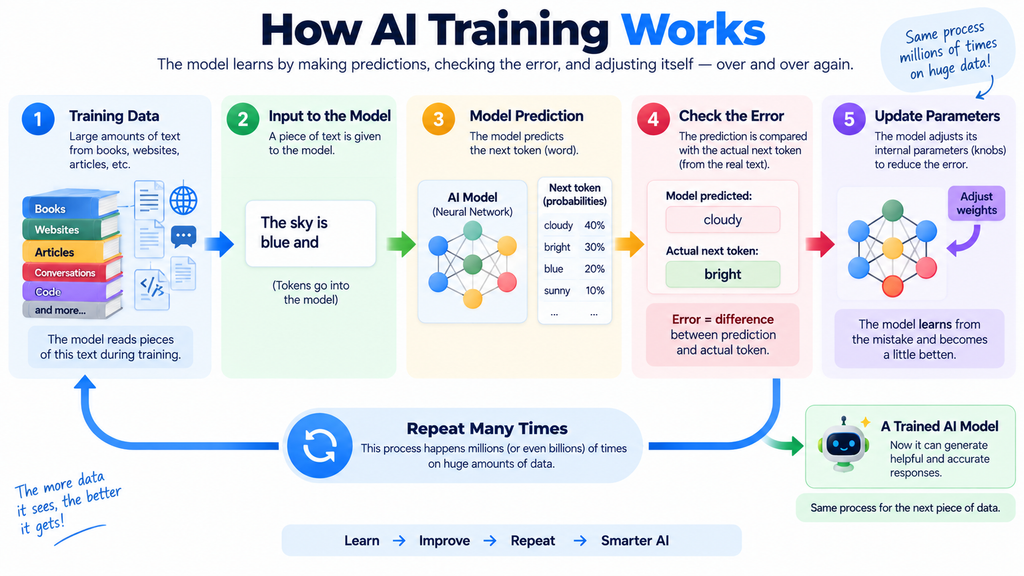
Imagine a system with a very large number of adjustable settings. At the beginning of training, those settings do not yet represent the useful solution the model needs.
The model processes an example and produces an output.
The training system then evaluates that output according to the training objective.
If the output is not good enough, the parameters are adjusted.
The model processes another example.
The process repeats.
Over many iterations, the parameters move toward configurations that allow the model to perform the task more effectively.
This is why the word “learn” can sometimes be misleading.
The model is not necessarily learning in exactly the same way a human learns. In the context of neural networks, learning means that an optimization process changes numerical parameters so the model performs better according to its objective.
The result can nevertheless be extremely sophisticated.
The transcript highlights this surprising property: large neural networks trained on sufficiently complicated problems can develop unexpected or “emergent” behaviors even though their underlying mathematical operations are comparatively simple.
How Does AI Training Work Step by Step?
Although real-world training systems can be extremely complicated, the central training loop can be understood through a few basic stages.
Step 1: Give the Model Training Data
The model first needs information from which it can learn.
The type of data depends on the task.
A vision model may work with images.
A speech model may work with audio.
A language model may work with text.
GPT provides a useful example because its training is described in the transcript as consuming a very large amount of text and trying to predict the next word or, more precisely, small chunks of words.
The data provides the material from which the model can discover patterns.
Step 2: Ask the Model to Make a Prediction
The model receives an input and produces an output according to its current parameters.
For a GPT-style language model, the basic objective can be expressed as:
Given the text so far → predict what comes next.
For example:
“The capital of France is…”
The model needs to determine what continuation is most appropriate based on its learned representations.
During training, this happens over enormous numbers of examples.
Step 3: Measure the Model’s Error
The system needs a way to determine how well the model performed.
The prediction is compared against the training target, and the difference contributes to a measure of error, commonly represented through a loss function.
The loss gives the optimization process information about how the model is performing.
If the model is consistently making poor predictions, its parameters need to change.
Step 4: Adjust the Parameters
This is where the actual “learning” takes place.
The training process calculates how the parameters should change to improve the model’s performance.
Techniques such as backpropagation and gradient descent are used to make these adjustments.
The transcript specifically describes backpropagation and gradient descent as optimization techniques used with neural networks and explains why a trainable architecture needs to work well with these methods.
Step 5: Repeat the Process
The model does not become capable after seeing one example.
The training process repeatedly exposes it to data and updates the parameters.
Over time, the model can learn increasingly useful patterns.
This repeated optimization is at the heart of neural-network training.
What Is a Neural Network’s “Training Knob”?
One of the most useful ideas in understanding AI training is the concept of a parameter.
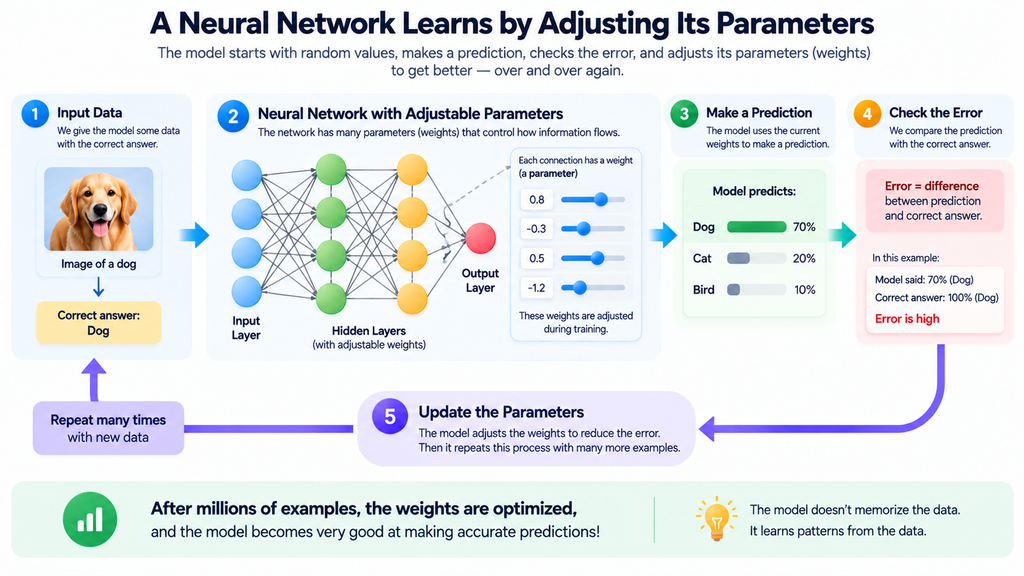
You can think of each parameter as an adjustable numerical value inside the neural network.
The transcript uses the analogy of “knobs” to explain these parameters. They are trainable and modifiable, and the objective is to find settings that make the neural network perform the desired task.
A modern neural network can have an enormous number of these parameters.
Training is therefore not someone manually turning each knob.
Instead, mathematical optimization methods determine how the knobs should be adjusted.
The surprising part is what can happen when there are many such parameters working together.
A sufficiently large neural network can represent complex patterns and computations that are difficult to predict simply by looking at individual parameters.
This is one reason AI training can produce capabilities that were not explicitly programmed as individual rules.
Why Does Gradient Descent Matter in AI Training?
A model needs a systematic way to improve.
Suppose the current parameters produce an imperfect answer.
How should the parameters change?
Gradient descent provides one method for answering that question.
In simple terms, it uses information about the direction in which the loss changes to determine how the parameters can be adjusted.
You can imagine standing on a landscape and trying to move toward a lower point.
Instead of knowing the entire landscape, you can examine the local slope and move in a direction that should take you downward.
AI training uses a mathematical version of this idea.
The model makes predictions, the training system calculates the loss and gradients, and the parameters are updated.
Then the model tries again.
This cycle is repeated at very large scale.
Why Is Backpropagation Important?
Gradient descent tells the optimization process how parameters can be adjusted, but a neural network may contain many layers of computation.
Backpropagation helps calculate how the error at the output relates to parameters throughout the network.
This allows the training process to determine how different parts of the network contributed to the final error.
The transcript describes transformers as being designed not only to perform expressive computations but also to be optimizable using backpropagation and gradient descent.
This matters because having a powerful mathematical system is not enough.
You also need to be able to train it effectively.
Why Does the Architecture Matter During AI Training?
The model’s architecture determines how information moves through the neural network and how the parameters interact.
Transformers are an important example.
The transcript explains that a transformer is not simply “attention.” It contains multiple architectural components, including attention, residual connections, multilayer perceptrons, layer normalization and other elements arranged into blocks.
One reason the transformer architecture became so important is that it combines several useful properties.
It can express complex computations.
It can be optimized through backpropagation and gradient descent.
And it can take advantage of parallel computing hardware.
The transcript describes this as a combination of being expressive, optimizable, and efficient for highly parallel hardware.
That combination is important because AI training is not only about what a model can theoretically represent.
It is also about whether that model can actually be trained efficiently.
How Is GPT Trained?
GPT offers one of the clearest examples of modern AI training.
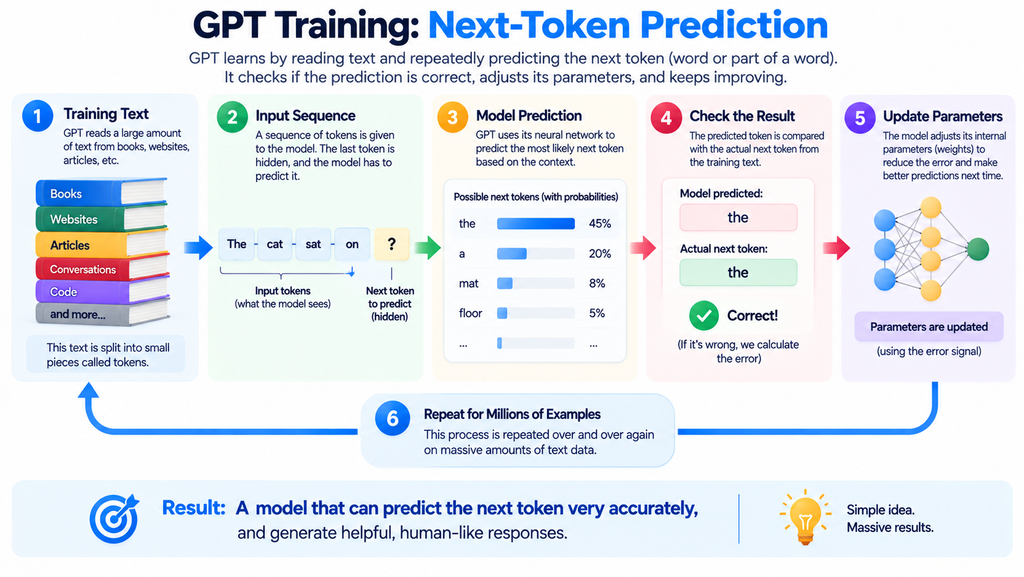
At a simplified level, GPT is trained as a language model.
The transcript describes the process as taking a massive amount of text and trying to predict the next word in a sequence, while noting that the actual prediction is more accurately performed over smaller chunks called tokens.
Consider a sentence:
“The child went to the…”
The model attempts to predict what comes next.
During training, the system knows the actual continuation from the training example.
The model’s prediction is evaluated.
Its parameters are adjusted.
Then another piece of text is processed.
This happens again and again.
The objective itself is simple.
But language contains enormous amounts of information.
To perform next-token prediction across a very large and diverse collection of text, the model has to capture many relationships within that data.
This is where things become much more interesting.
Why Can Next-Token Prediction Teach an AI So Much?
At first glance, predicting the next word seems like a narrow task.
But consider what is required to predict language in different situations.
A sentence about chemistry follows different patterns from a sentence about history.
A technical explanation follows different patterns from a conversation.
A mathematical problem follows different patterns from a story.
The transcript makes this point by explaining that when a powerful neural network is trained at sufficient scale on large amounts of text, next-word prediction effectively involves many different kinds of problems at once, including patterns related to areas such as chemistry, physics, and human behavior.
In other words, the training objective may look simple while the underlying problem is extremely rich.
To predict what comes next accurately, the model needs useful internal representations of the context.
This is one explanation for why large language models can display capabilities that were not separately programmed as individual features.
What Are Emergent Abilities in AI Training?
An emergent ability refers to a capability that appears as a model becomes sufficiently capable or as training reaches a particular scale.
The transcript repeatedly discusses this surprising behavior in large neural networks.
A neural network can begin with relatively simple mathematical operations, yet training on a difficult enough problem can lead to complex behavior.
GPT is a strong example of this idea.
The model is trained around language prediction, but after sufficient training, it can be prompted to perform different kinds of tasks.
The transcript specifically discusses in-context learning, where a GPT model can be prompted with examples or instructions and then continue the pattern to perform a task.
This is different from manually programming a separate rule for every task.
What Is In-Context Learning?
In-context learning is the ability of a trained model to adapt its response based on information provided within the current context.
For example, a prompt can provide examples showing a particular input-output pattern.
The model can then use those examples to infer what kind of response is expected.
The transcript describes this as a notable capability associated with GPT: the model can be prompted in different ways and can complete the requested pattern without necessarily requiring a separate training process for each task.
This creates an important distinction.
A model can learn general capabilities during large-scale training and then use those capabilities to perform new tasks with relatively little task-specific information.
Does More Data Always Make AI Better?
The transcript presents scale as an important part of modern AI progress, particularly for large language models.
However, the idea is not simply “more data equals better AI.”
The quality and usefulness of the training problem matter.
The architecture matters.
The optimization process matters.
The available computing resources matter.
And the way the model is evaluated matters.
The transcript notes that recent progress has involved increasing datasets and evaluations while keeping the transformer architecture relatively stable.
This illustrates an important point about AI training: progress can come from scaling different parts of the overall system rather than constantly replacing the underlying architecture.
Why Can Pretraining Make AI More Data Efficient?
One of the most interesting ideas in the transcript is the relationship between large-scale pretraining and learning new tasks with fewer examples.
A model can first be pretrained on a massive dataset.
That gives it broad representations.
Later, it may be possible to use only a small number of examples to perform a particular task.
The transcript gives examples such as sentiment analysis and translation, where a pretrained GPT-like model can be shown a small number of examples and then complete the pattern.
This can be thought of as two different levels of learning.
Large-scale pretraining:
The model develops broad representations from a massive dataset.
Task adaptation:
The model uses those existing representations to handle a new task with relatively little additional information.
This is one reason pretraining became such an important idea in modern AI.
Why Was Training AI From Scratch Difficult for Some Tasks?
The transcript also provides an example from the World of Bits project.
The idea was to give a neural network access to a computer’s keyboard and mouse and have it interact with websites.
The problem was that an agent starting randomly had very little useful knowledge about what buttons, images, bookings, or interfaces meant.
It had to explore possible actions and receive rewards, but successful outcomes could be extremely rare.
This created a difficult training problem because there were many possible actions and the reward signal was sparse.
The later idea was to start with a pretrained GPT-like model rather than starting completely from scratch.
The pretrained model already had useful representations of language and concepts such as a booking or a submit button.
That made the subsequent training problem much more tractable, according to the discussion in the transcript.
This example illustrates a broader lesson:
An AI does not always need to learn everything from zero.
A powerful pretrained model can provide a starting point for learning additional tasks.
Does AI Training Teach an AI About the Real World?
This question becomes especially important for language models.
A model trained on text can learn a great deal from written information.
But text does not contain every aspect of human experience.
The transcript points out that humans leave many everyday facts unstated because they are obvious to people who share physical experience of the world.
For example, people do not need to explain every time that objects fall when dropped.
We experience physical reality directly.
Text is primarily a communication medium.
This raises an important limitation: training on text can provide enormous amounts of information, but text is not necessarily a complete representation of the physical world.
The transcript therefore discusses the importance of other forms of information, including images, video and audio.
Can AI Learn From Images, Audio and Video?
Yes, AI systems can be trained using different types of data, and the transcript discusses the importance of moving beyond text.
Images provide visual information.
Audio provides information about sound and speech.
Video provides information about how visual scenes change over time.
Combining multiple types of information can potentially give AI systems access to aspects of the world that are difficult to represent through text alone.
The transcript describes this broader multimodal direction as an important area of interest, while also emphasizing that text alone may not be a complete source of knowledge about the world.
What Happens After AI Training Is Finished?
Once a model has been trained, it can be used to perform its intended task.
For a language model, this is generally called inference.
Training changes the model’s parameters.
Inference uses the trained model to process new inputs and generate outputs.
This distinction is fundamental.
During training:
Data → Prediction → Error → Parameter update
During inference:
Input → Trained model → Output
When you type a question into an AI application, you are normally interacting with a trained model rather than watching the entire training process happen again from the beginning.
Why Is AI Training So Difficult?
The basic idea of training a neural network is relatively easy to describe.
Doing it at large scale is another matter.
A modern AI training system may involve:
- enormous datasets,
- large neural networks,
- huge numbers of parameters,
- repeated mathematical operations,
- optimization algorithms,
- distributed computing,
- specialized hardware,
- and extensive evaluation.
The transformer architecture is particularly relevant because it is designed to take advantage of parallel computation.
The transcript explains that hardware such as GPUs benefits from large amounts of parallel computation, and that the transformer architecture was designed with this kind of efficiency in mind.
So AI training is not simply a software problem.
It is also a computing and engineering problem.
Is AI Training the Same as Human Learning?
Not exactly.
The transcript specifically cautions against taking the analogy between artificial and biological neural networks too literally.
Artificial neural networks may have been inspired historically by ideas about biological neurons, but the optimization process that produces a trained artificial neural network is very different from the processes that produced biological brains through evolution and development.
This distinction matters.
Calling something a “neural network” does not mean that it works like a human brain.
AI training is based on mathematical optimization of an artificial computational system.
Human learning involves biology, perception, memory, development, motivation, interaction with the physical world and many other processes.
The similarities can be useful for intuition, but the differences are equally important.
The Simple Idea Behind a Surprisingly Complex Technology
So, what is AI training?
At its core, it is the process of adjusting a model’s parameters so that it becomes better at a defined objective.
The process can be summarized simply:
1. Provide data.
2. Make a prediction.
3. Measure the error.
4. Calculate how the model should change.
5. Update the parameters.
6. Repeat at large scale.
The remarkable part is what can emerge from this process.
A neural network may contain mathematical operations that appear relatively simple individually. Yet when a large number of adjustable parameters are optimized on a difficult problem using huge amounts of data, the resulting system can develop sophisticated capabilities.
GPT demonstrates this particularly clearly.
Its basic language-model objective can be described as predicting the next token. But doing that well across a huge and varied collection of text requires the model to capture relationships and context within the data. The transcript connects this process to capabilities such as in-context learning and other emergent behaviors.
That is the central idea behind AI training:
The intelligence does not come from manually writing every answer into the machine. It emerges from the interaction between data, architecture, parameters, optimization and computation.
And that is why understanding AI training is one of the best starting points for understanding how modern AI systems actually work.
Frequently Asked Questions
What is AI training in simple words?
AI training is the process of teaching an AI model by using data and repeatedly adjusting its internal parameters so that it becomes better at a particular task.
What does an AI learn during training?
An AI model learns patterns and relationships in its training data by changing its parameters through an optimization process.
What are parameters in AI?
Parameters are numerical values inside a neural network that can be adjusted during training. The transcript compares these adjustable values to “knobs” that need to be set correctly for the network to perform a desired task.
How is GPT trained?
At a simplified level, GPT is trained on large amounts of text and learns to predict the next token in a sequence. The transcript describes this as predicting the next word, while noting that the actual units are smaller word chunks or tokens.
What is gradient descent in AI training?
Gradient descent is an optimization method used to adjust model parameters in a direction intended to reduce the model’s loss.
What is backpropagation?
Backpropagation calculates how the model’s output error relates to parameters throughout the neural network, helping optimization methods update those parameters during training.
Is AI training the same as programming?
Not in the traditional sense. Traditional programming often involves explicitly writing rules for a system to follow. Neural-network training instead uses data and optimization to adjust the model’s parameters so it can learn useful patterns.
Does an AI model learn everything from scratch?
Not always. Large pretrained models can already contain useful representations that make learning or adapting to additional tasks more efficient. The transcript uses GPT’s pretrained representations as an example of this idea.
Why does AI need so much training data?
Large datasets can expose a model to many different patterns and contexts. In the case of language models, the transcript explains that predicting the next token across large amounts of text effectively involves learning patterns from many different areas of information.
Can AI learn from more than text?
Yes. The transcript discusses images, audio and video as additional sources of information and notes that text alone may not contain all the information needed to represent the physical world.
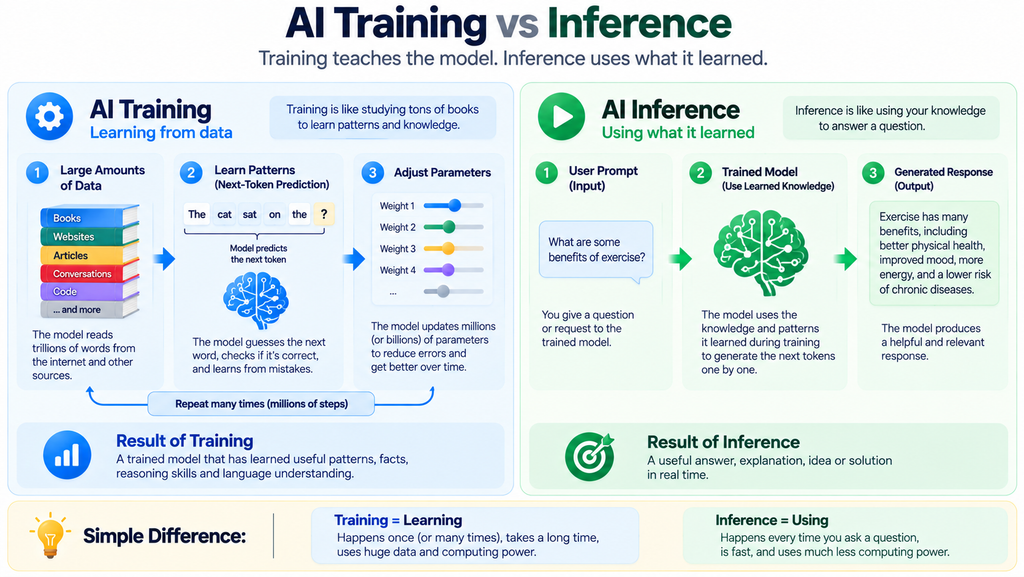
What is the difference between AI training and inference?
Training changes the model’s parameters using an optimization process. Inference is when the trained model is used to process new input and produce an output.
Internal Link’s
[INTERNAL LINK: What Is Artificial Intelligence?]
[INTERNAL LINK: How Do Large Language Models Work?]
[INTERNAL LINK: What Is a Transformer in AI?]